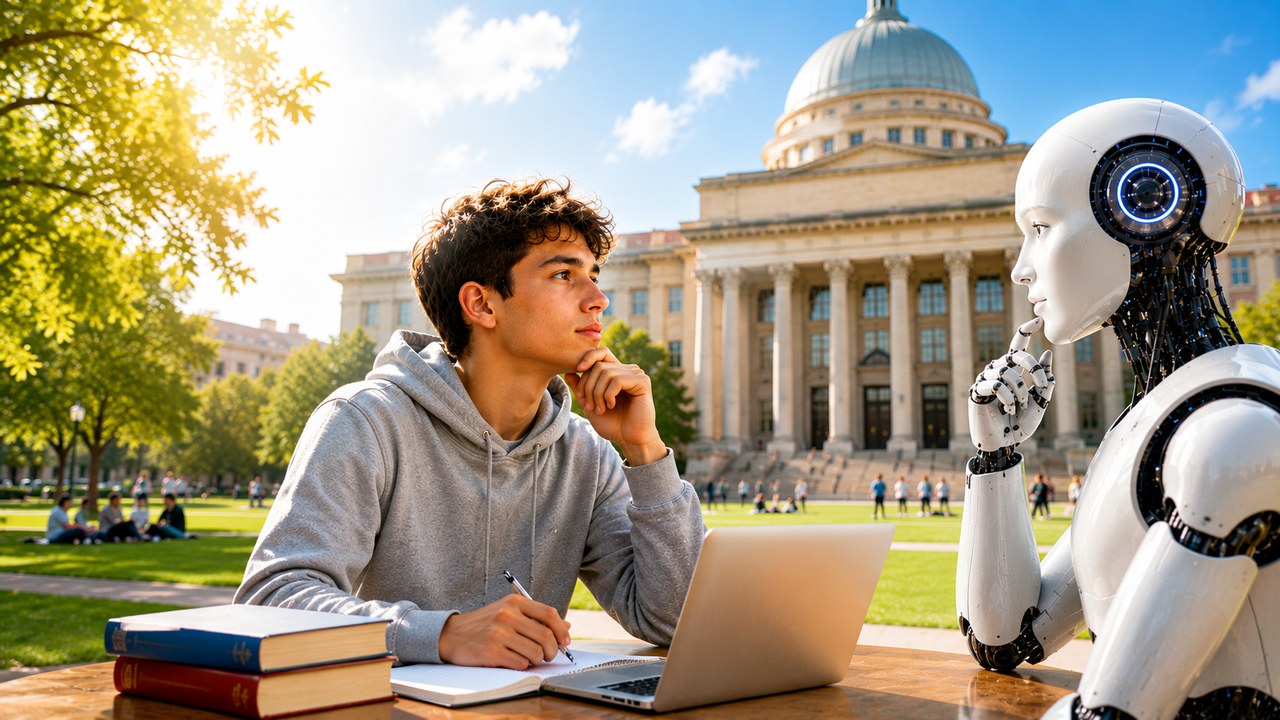
Artificial intelligence was sold to the public as the ultimate productivity booster. The deal seemed straightforward: algorithms would handle the tedious busywork—formatting spreadsheets, drafting template emails, summarizing long documents—so humans could focus on higher-level critical thinking, strategy and judgment.
A report from the Massachusetts Institute of Technology (MIT) challenges the comfort of that premise.
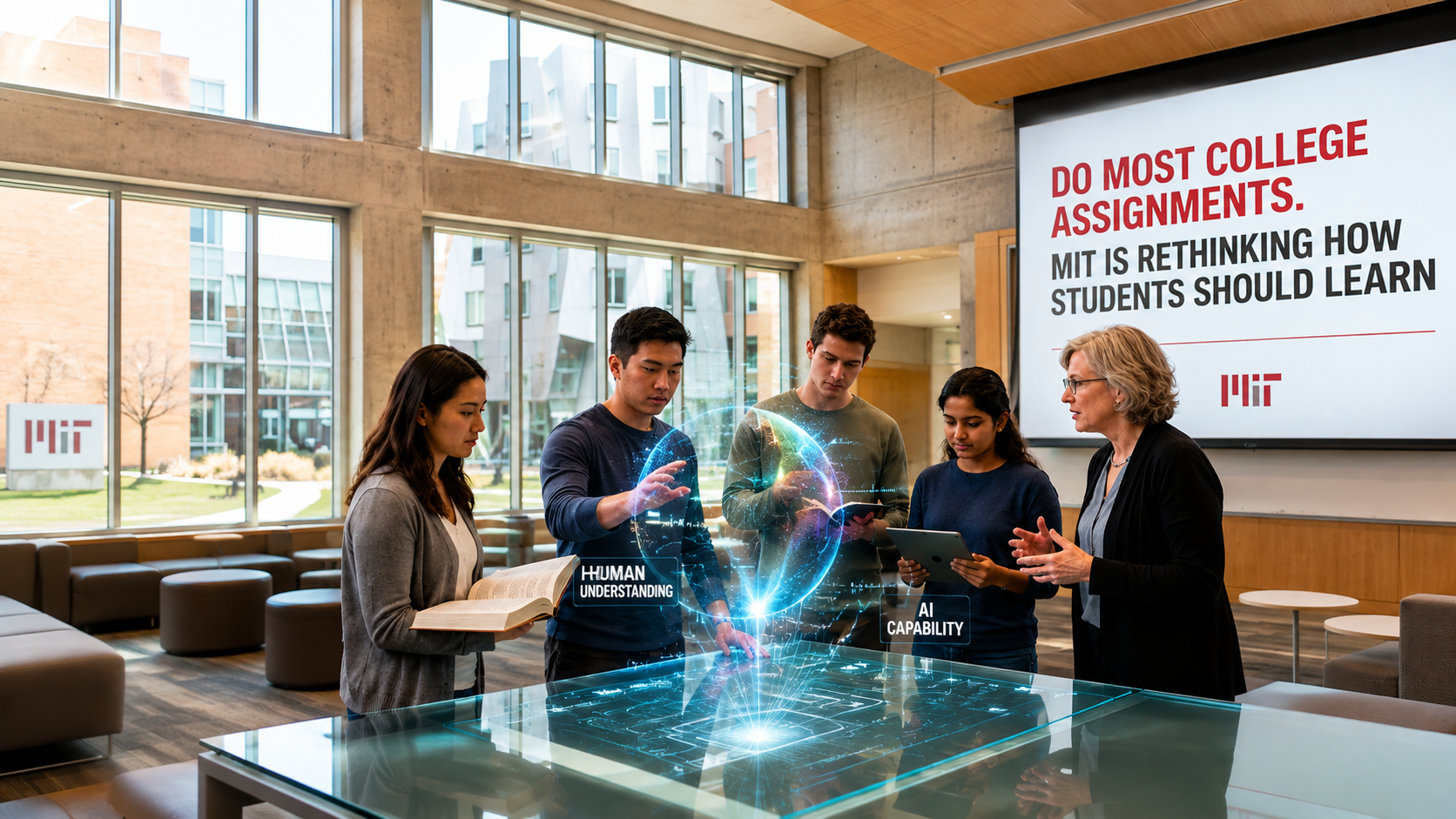
After examining the impact of generative AI on higher education, an MIT committee concluded that today's systems can already credibly complete most undergraduate assignments. MIT President Sally Kornbluth described the moment as a "watershed" for the university and for higher education at large.
This isn't simply about students using ChatGPT to cut corners on a homework assignment. It's an early signal of a much bigger shift in how we teach, how we determine whether someone has actually learned something and, ultimately, what human knowledge is worth in an age when a machine can produce the answer almost instantly.
The Struggle Was Always the Point
For generations, higher education operated on a relatively simple loop: a professor assigned a problem, a student struggled through it, and the final paper, calculation or piece of code provided evidence that the student had learned something.
The struggle was part of the process. Anyone who has stayed up late trying to debug a script, structure an argument or master calculus understands that confusion and error aren't necessarily failures of learning. Quite often, they are how learning happens.
Generative AI changes that relationship.
A student struggling to begin an essay can ask an AI system to help develop an outline or explain a difficult concept. Someone facing a dense research assignment can use the technology to summarize sources and identify competing arguments.
The assistance can go much further. AI can polish prose, generate computer code, analyze information and help assemble a finished assignment. The result can look impressive even when the student has done relatively little of the intellectual work required to produce it.
That presents universities with a problem that cannot simply be solved by detecting whether AI was used.
MIT's response is therefore significant. Rather than relying solely on an escalating battle between increasingly capable AI systems and AI-detection software, the university is considering changes to how students are assessed. Oral examinations, project portfolios and in-person discussions tied to work completed outside the classroom could become more important.
There is an interesting irony in that response. Some of the world's most advanced technology may force universities to return to one of education's oldest methods: a knowledgeable person sitting across from a student and asking, "Why do you think that?"
Beyond the Campus: The Job Market Reality
The problem does not end when students graduate.
Higher education prepares millions of people for cognitive work. Lawyers research and construct arguments. Software developers write and troubleshoot code. Financial analysts examine data. Researchers synthesize information. Accountants prepare and analyze financial records.
AI is increasingly capable of assisting with—and in some cases performing—portions of all of those tasks.
Consider a department where three employees were previously required to conduct research, analyze information and prepare reports. If one employee equipped with increasingly sophisticated AI tools can eventually produce comparable output, a business has an obvious economic incentive to reconsider how many employees it needs.
That does not necessarily mean entire professions suddenly disappear.
The more likely near-term effect is task erosion.
AI takes over one function, then another. The profession remains, but the volume of human work required to perform it declines. Eventually, fewer tasks can translate into fewer people.
That distinguishes the current technological transition from many that came before it.
When industrial machines automated physical labor, workers increasingly migrated toward jobs requiring cognitive skills. Modern economies were built partly around the assumption that human intelligence remained the comparative advantage machines couldn't easily reproduce.
Generative AI is moving directly into that territory.
The Risk of Cognitive Atrophy
Describing artificial intelligence as a "new species" is scientifically imprecise. AI doesn't have to sleep, but neither does it possess biological life simply because it can generate intelligent responses. There is also no basis for assuming that today's generative systems experience consciousness in anything resembling the human sense.
Economically, however, consciousness isn't necessarily the determining factor.
Capability is.
If software can reliably perform a task faster and more cheaply than a person, businesses have an incentive to use it regardless of whether the software understands what it is doing in a human sense.
But there is another consequence that may be less visible than job displacement: cognitive atrophy.
AI can be an extraordinary educational tool when it helps someone understand a difficult concept. A student can ask for another explanation of calculus, practice a foreign language, test an argument or ask why a piece of computer code isn't working.
The danger emerges when assistance becomes substitution.
If AI routinely reads for us, writes for us, analyzes information for us and synthesizes arguments for us, we may gradually exercise those cognitive abilities less frequently.
The immediate result is greater productivity.
The longer-term consequence could be greater dependency.
Society could eventually arrive at a strange paradox in which our technology becomes progressively more capable while our own ability—or willingness—to perform certain forms of critical thinking gradually declines.
What Are We Actually Training Students to Do?
This may be the most important question raised by MIT's report.
If students can push a button and receive an answer, what exactly should universities be teaching them?
The answer cannot simply be to prevent them from pushing the button.
When those students enter the workplace, their employers may expect them to use AI. A financial institution isn't likely to reward an analyst for taking four hours to complete something safely and accurately with traditional methods if AI allows another analyst to accomplish it in 20 minutes.
Education therefore has to evolve beyond simply teaching execution.
Students still need foundational knowledge because they cannot reliably evaluate an AI-generated answer if they don't understand the subject themselves. An accountant must know enough accounting to recognize when an AI-generated analysis is wrong. An engineer cannot simply trust an AI-designed structure because the software produced an impressive calculation. A physician using AI-assisted diagnostics still needs the medical knowledge and judgment necessary to challenge the machine.
The value of education may therefore increasingly shift from producing the answer to understanding, interrogating and validating the answer.
That represents a significant change in what it means to be educated.
Preserving What Makes Humans Valuable
None of this means human labor is doomed.
Major technological shifts have historically eliminated some forms of work while creating others. AI could generate industries and occupations that barely exist today. It could also make existing workers dramatically more productive rather than simply replacing them.
Human judgment, relationships, leadership, ethics, creativity and accountability will remain particularly important in situations where getting something wrong has serious consequences.
But assuming everything will automatically balance itself out would be a dangerous gamble.
Universities have an especially important role because they are responsible for preparing the people who will enter this changing economy.
The objective cannot be to educate students for the workplace of 2006, or even 2026, if the workplace of 2036 operates fundamentally differently.
Students need to understand how to use AI, but they also need enough independent intellectual capacity to function without blindly depending upon it.
We started building artificial intelligence to lighten our workload. As universities redesign how they teach, assess and certify knowledge, they must ensure they aren't inadvertently creating a world in which human critical thought becomes the optional part of the equation.
MIT's warning should therefore be viewed as more than an education story.
It is an early glimpse of a much larger question confronting society as machine intelligence improves:
If AI can increasingly execute the work we are sending people to university to learn how to do, what exactly are we training the next generation of humans for?