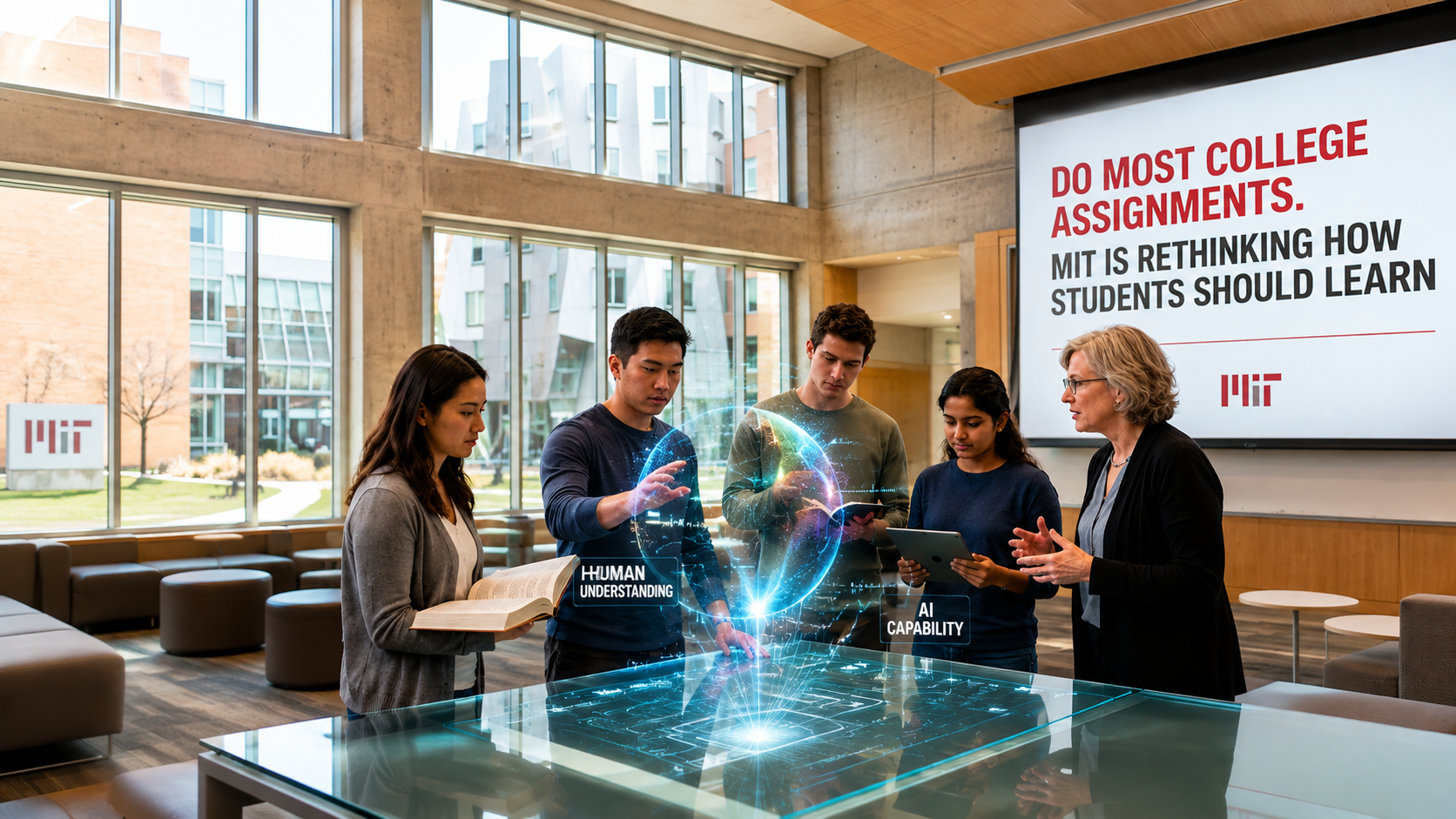
MIT has raised an important concern about artificial intelligence and higher education. Its committee studying AI concluded that today's systems can already credibly complete most undergraduate assignments, forcing universities to rethink how students are taught and assessed.
But perhaps there is a more uncomfortable question: Is this partly about preserving the university itself?
Universities are trying to figure out how AI fits into courses and examinations. They should also consider whether AI eventually changes our need for parts of the traditional university model.
For centuries, universities provided access to knowledge and to people qualified to teach it. The internet weakened the first advantage. AI could challenge the second.
Why couldn't AI teach us?
A good teacher explains a subject, answers questions, recognizes when a student is struggling, tries another approach and determines whether the student understands.
AI is increasingly capable of doing many of those things. More importantly, it can potentially provide something even an excellent professor cannot easily offer: individual attention to every student.
Traditional education is organized around groups even though people don't learn at the same pace.
Put 100 students in a lecture hall and some will understand the material immediately. Others will need several explanations. Some may already know enough to be bored. The professor has little choice but to keep everyone moving at roughly the same pace.
AI could build the instruction around the individual instead.
If you understand something, move on. If you don't, stay with it. Try another explanation. Work through another example. Test it again.
That raises questions about structures we've taken for granted. Why should every course take a semester? Why should everyone progress at the same speed? Why should a degree take four years if one person can demonstrate mastery sooner while another needs longer?
Those structures made practical sense when one teacher had to educate many students simultaneously. AI doesn't necessarily have that limitation.
What AI can't easily replace
There is a problem with taking that argument too far.
Learning isn't simply the transfer of information.
Students learn through disagreement, group projects, difficult professors and conversations that take unexpected turns. The classmate who challenges your argument may teach you something an AI tutor designed around your preferences doesn't.
There is also discipline.
Self-paced education sounds wonderful until everything can be done tomorrow. Deadlines, classmates and scheduled classes create pressure to keep moving. Many young students still need that structure.
Universities also provide something AI currently cannot: a trusted credential.
An MIT degree doesn't simply tell an employer that someone studied engineering. MIT selected that person, assessed the work and put its reputation behind the qualification.
Someone might eventually learn the same material using an AI tutor at home. The problem is proving it.
That could change if employers increasingly use competency tests, portfolios and practical assessments. Until then, the university degree remains a powerful signal.
What happens to the professor?
AI doesn't necessarily eliminate professors, but it could change what we need them for.
If AI becomes excellent at explaining routine material, answering questions and providing personalized practice, professors may spend less time delivering information and more time mentoring students, supervising research, leading debates and challenging their thinking.
That may actually make teaching better.
The professor becomes valuable not because he or she possesses information students cannot obtain elsewhere, but because experience, judgment and human interaction add something the machine cannot.
What should humans still learn?
Then comes the harder question.
If AI can provide information instantly—and eventually perform more of the intellectual work done by programmers, accountants, analysts and other professionals—what should humans spend years learning?
Certainly not nothing.
We need enough knowledge to recognize when AI is wrong.
But education may shift away from memorizing information and toward understanding concepts, evaluating evidence, solving unfamiliar problems and exercising judgment.
Knowing the answer becomes less valuable when everyone has access to a machine that can provide one. Knowing whether the answer makes sense becomes much more important.
Maybe AI doesn't kill the university
MIT's warning about AI completing undergraduate assignments may therefore be the beginning of a much larger conversation.
AI could eventually provide highly personalized education at very low cost. That will force universities to justify expensive four-year degrees, standardized semesters and large lecture halls.
Some parts of the traditional model may disappear.
Others may become more valuable.
Students still need structure. Employers need trusted credentials. Scientists need laboratories. Young adults benefit from interacting with other people. Ideas improve through argument and collaboration.
Perhaps AI doesn't eliminate universities.
It forces them to stop being expensive information-delivery systems and concentrate on what humans actually add: mentorship, discipline, debate, collaboration and discovery.
MIT is asking what happens when AI can complete the student's assignment.
The more consequential question is what happens when AI can teach the student.
If it can, universities may finally have to answer a question they've rarely been forced to confront: What do we actually need the classroom for?